How Much Savings Do You Really Need Before Buying a Home?
Buying a home is one of the biggest financial steps, and the listed price is only part of the picture. Between the down payment, government charges, loan fees, and move-in expenses, the actual savings target looks quite different from the headline number on a property listing.
This guide breaks down each layer of cost, from RBI-linked down payment requirements to stamp duty and emergency reserves.
Understanding the true cost of buying a home
The property price gets all the attention, but several additional expenses shape how much savings a buyer should actually need. Stamp duty and registration charges are the most significant of these. The government levies together add a notable share to the total property value.
Beyond statutory charges, here are the other costs that sit outside a typical home loan sanction:
Loan processing fees: Charged by the lender as a fraction of the sanctioned loan amount.
Legal and technical verification: Covers the lender's due diligence on title and property condition.
Interior fit-out budget: Especially relevant for premium homes where personalisation is expected.
Home insurance premium: Often required by lenders before disbursement.
Factoring these costs early gives a realistic target rather than an unpleasant surprise to the buyer.
Down payment and home loan eligibility
The down payment is where most of your upfront savings go. Under RBI and NHB guidelines, lenders can only finance a defined share of the property value (the loan-to-value ratio, or LTV). The rest is your contribution.
A higher down payment reduces your borrowed amount, which in turn lowers your monthly EMI and total interest outgo. Lenders also tend to offer more favourable terms when the borrower's upfront contribution is strong, because it signals lower lending exposure. Your credit score, income stability, and existing liabilities all influence the final loan terms as well.
Planning with a home loan EMI calculator
Once you have a sense of the down payment and ancillary costs, a home loan EMI calculator helps you model realistic monthly outflows. These tools estimate your instalment based on three inputs: loan amount, interest rate, and tenure.
A shorter loan tenure means you pay less interest overall, but your monthly EMI is higher. A longer tenure eases monthly cash flow, but the cumulative interest adds up. Many buyers find it helpful to test multiple scenarios, adjusting the loan amount and tenure until the EMI sits comfortably within their monthly budget.
Building your savings and keeping an emergency buffer
A structured, multi-bucket approach works best when saving for a home. Your down payment corpus is the primary bucket, but it should sit alongside two other reserves: statutory costs (stamp duty, registration, processing fees) and an emergency fund.
On the down payment front, salaried buyers now have access to a useful tool. According to BusinessToday, revised EPF withdrawal rules allow first-time homebuyers to access a significant portion of their provident fund corpus after a reduced membership period. This can meaningfully accelerate the savings timeline for eligible buyers.
The emergency fund reserve should cover three to six months of essential living expenses and stay entirely separate from your property savings.
Here is how to think about your savings in layers:
Bucket 1: Down payment (governed by LTV requirements)
Bucket 2: Stamp duty, registration, and ancillary charges
Bucket 3: Emergency fund (liquid, separate, untouched by the purchase)
Bucket 4: Interior and move-in costs (especially for premium homes)
Keeping these buckets distinct prevents a situation where a large down payment leaves you short on liquidity after possession.
Bringing it all together
The question of how much savings you need before buying a home has a layered answer. It starts with the down payment, extends to stamp duty and loan processing costs, and includes a separate emergency reserve.
Using a home loan EMI calculator early in the process helps connect these numbers to your monthly income and spending comfort. A well-planned savings strategy, spread across distinct buckets, puts you in a strong position when the right property comes along. Birla Estates brings this same clarity to every development, where considered design, transparent processes, and attention to detail ensure that buyers can approach ownership with confidence and assurance.
Frequently asked questions
1. How much total savings do I need before buying a home?
Your target should cover the down payment, stamp duty and registration charges, loan processing fees, and an emergency buffer of three to six months' expenses. The exact figure depends on property value and your state's stamp duty rates.
2. What is LTV ratio, and how does it affect my down payment?
LTV (loan-to-value) is the share of the property cost a lender will finance. RBI caps this ratio based on property value brackets. The gap between the property price and the LTV-covered amount is your minimum down payment.
3. Can I use my EPF savings for a home down payment?
Eligible salaried members can withdraw a significant portion of their EPF corpus for a first home purchase after meeting a minimum membership period. Recent rule changes by the government have made this process easier for younger employees.
4. How does an EMI calculator help me plan my savings?
It estimates your monthly instalment based on loan amount, interest rate, and tenure. By testing different scenarios, you can identify a comfortable EMI and work backwards to set your down payment and savings target.
5. Are stamp duty and registration charges covered by the home loan?
No. These statutory charges fall outside the lender's LTV calculation and must be paid from personal savings.
Recommended
 7 MIN READ
How to Compare Different Properties?
Comparing homes on price and size alone misses what shapes long-term living. This guide walks through connectivity, carpet area, amenities, hidden charges, legal approvals and developer history to help buyers evaluate properties more completely.
 8 MIN READ
Best Security Systems for New Homes
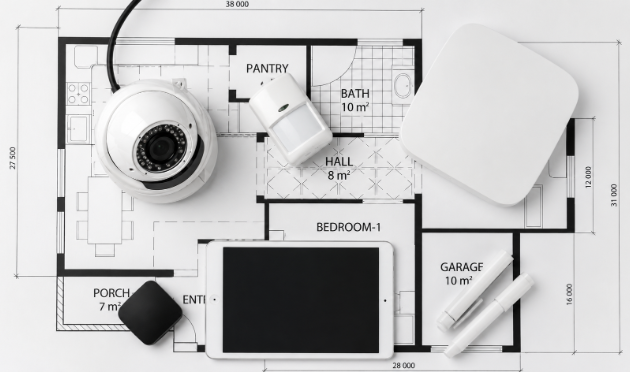
A guide to home security systems for new homeowners, covering smart locks, CCTV, alarms, video doorbells, motion sensors, and professional monitoring, with tips for apartment living.
 8 MIN READ
Is Home Loan Insurance Necessary? A Complete Guide for Indian Homebuyers
Is home loan insurance necessary in India? Understand how it works, its types, coverage, benefits, costs and alternatives, and learn what to consider before choosing a policy for your home loan.